
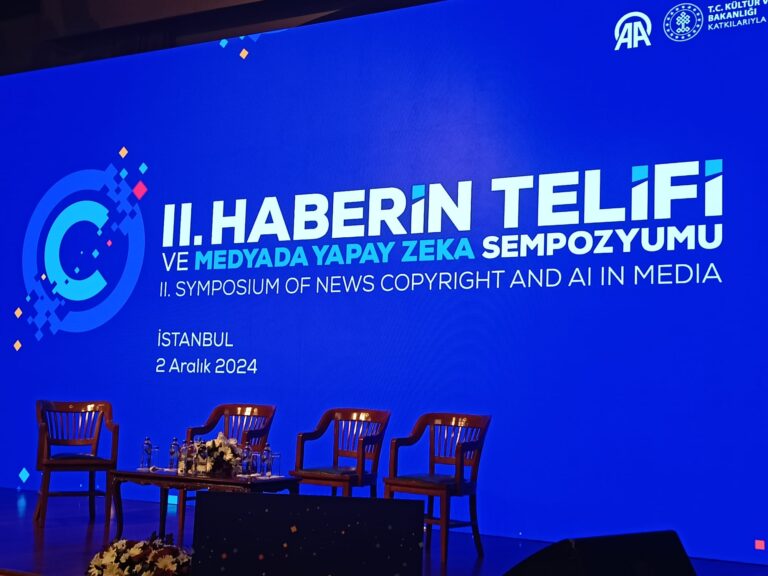
The development of new media has changed mass communication to such an extent that our habits and institutions inherited from traditional media remain ineffective in the face of contemporary requirements. This issue, concerning the copyright problem of journalists against developing technology, was addressed at the II. Symposium on News Copyright and Artificial Intelligence in Media, organized at Boğaziçi University with the collaboration of Anadolu Agency and the contributions of the T.R. Ministry of Culture and Tourism.
Mr. Serdar Karagöz, Director General of Anadolu Agency, one of the opening speakers of the symposium, stated that with technology gaining a new dimension every day, we are going through a process of **hyper-innovation**, and society is exhibiting **hyper-adaptation** in the face of this. He emphasized that digital technologies, which were once hoped to democratize information, are now creating **big-tech giants** like Google and Meta, which monopolize the distribution of information. He then explained that the quality of journalism has declined both in Turkey and worldwide, and the profits obtained by news organizations have decreased with the growth of big-tech giants, stating that the **financing of the media** is the most critical issue to be solved.
Prof. Dr. Fahrettin Altun, Director of Communications of the Presidency, further concretized this situation in his speech. Altun explained that the fact that journalism is not covered by copyright, on the grounds that it only involves the transfer of facts, despite being a job that requires great effort and sacrifice, is incompatible with today’s realities. He drew attention to the fact that social media companies, which benefit from the news produced by journalists free of charge, are exploiting Turkey’s news agencies and news organizations. Stating that legal regulations are necessary to protect the copyright of news, Altun added that this would also establish ethical rules in the media and contribute to the fight against negative issues such as disinformation.
In the sessions held after the opening speeches, examples from other countries were first addressed. The subject was examined separately concerning intellectual and industrial property rights and competition law. The status of news copyright in Turkey was discussed, and the direction of the planned regulation was debated.
As extensively discussed in the symposium: Articles 36 and 37 of the Law on Intellectual and Artistic Works make it possible to **freely quote news**. Therefore, unlike other works, news does not benefit from copyright protection. Consequently, it is self-evident that the Turkish legislator prioritizes the public’s right to information. While this situation has continued to this day, the conditions have now changed against news producers due to applications like **”snippet”** developed by Google. Search engines or generative AI tools transmit information compiled from news sources to their users but do not provide any financial compensation to these sources. Another effect of this situation is that reader demographics are increasingly directing themselves to these applications, not even visiting the sources, even if the source is cited. Thus, news sites experience a decline in visitor numbers and revenues. In short, search engines are now **swallowing the sources** they make accessible.
In our opinion, this situation is related to **”convergence,”** a characteristic of new media. Convergence in media refers to the merging of many mass communication tools into one device as a result of technological development. For example, today’s mobile phone hardly resembles the state in which it was invented by Alexander Graham Bell. Today, mobile phones are not just tools for voice communication; they also perform the functions of cameras, computers, and many other devices.[1] That is, they have converged all these features within themselves. While Google essentially entered our lives as a search engine, it has gone far beyond this today with the other services it provides. Therefore, applications like snippet are merely another result of convergence.
The problem of news copyright is related, in another aspect, to **”technofeudalism.”** Technofeudalism refers to the economic model in which large technology companies monopolize through the technological possibilities they provide.[2] In this framework, large IT companies (e.g., Amazon) are likened to the **lords** of the feudal period, and those who sell products or offer services on these digital platforms are likened to the **serfs** working on the lord’s land.[3] For our topic, Google has created an information domain through the access it provides. Today’s journalists mostly reach their audiences through this search engine. However, with the developments we have mentioned, Google has gained an advantageous position in the market against journalists and is gradually taking over their function.
This situation is a fundamental problem for journalism, which is a public profession. As such, the protection of journalists and journalism is of great importance. We believe that a solution is needed that does not commodify news and does not impose a financial or other burden on the masses to benefit from their freedom to receive news. Since the source of the problem is the technology giants, the legal regulation should aim to protect journalists from the exploitation of these companies.
The symposium fundamentally addressed an important issue like news copyright. The fact that the impact of artificial intelligence was also touched upon, and that this problem is a result of new media technologies, made the symposium even more fruitful. However, we believe that it would be appropriate for future events to address the issue specifically in the context of convergence and technofeudalism.
Av. Celil Aktaş, LL.M.
Notes
[1] For explanations in this direction, see: AKTAŞ, Celil, “İnternet Üzerinden İşlenen Dezenformasyon Suçları”, Seçkin, Ankara, 2024, p. 40-41.
[2]HARRIS, Malcolm, Are We Living Under Technofeudalism?, “Intelligencer”, T.28.10.2022, https://nymag.com/intelligencer/2022/10/what-is-technofeudalism.html Erişim: 03.12.2024.
[3]McMANAGAN, James / STRACHAN, Claudia / FORNO, Micheal, What is technofeudalism and are we living under it?, “abc.net”, T. 05.11.2023, https://www.abc.net.au/news/2023-11-05/what-is-technofeudalism-and-are-we-living-under-it/103062936?utm_campaign=abc_news_web&utm_content=link&utm_medium=content_shared&utm_source=abc_news_web Erişim: 03.12.2024.